Tuesday, August 27, 2013

Ludum Dare #27 (10 Seconds): A post-mortem

WTF is Ludum Dare?
Ludum Dare is a friendly competition among game developers to see who can make the best game based on a given theme in 48 hours. This was the 27th competition, and the theme was "10 seconds."

Why did I want to participate?
For a long time, I've been looking at the game development community from the outside with a lens that I feel a lot of people tend to see through. I've always considered game development an extremely intricate and difficult field to enter, and I was scared of trying my hand at it for a long time. I have made small clones of other games (pong, sokoban, etc) and I have enjoyed making those games, but they're both relatively simple (exercise-sized, almost, to a certain extent). I have been wanting to get a little further into the game development scene for a while, and Ludum Dare seemed like the perfect opportunity. I've se
en several Ludum Dare competitions go by over the past couple of years and I never thought I was good enough to actually do it. This time, I just went for it, and I'm really glad I did.

What did you make?
When the theme "10 seconds" was announced, I had a billion and one ideas going through my head, because it's so open-ended. Everyone's first idea was to make a 10-second game, but that doesn't really work, so you had to move on to the next thing. I bounced a couple of ideas around in my head, but I ultimately decided to make a twin-stick roguelike-like because:
  1.  Movement and collision detection is relatively simple to implement, and
  2.  As all of my friends know, I'm a big fan of The Binding of Isaac, and I'm always thinking about how that game and games similar in nature to it are put together.
I ended up calling my game "Wappansai!" because it was one of the random strings I stuck in as a debug message as I was developing. It doesn't mean anything other than that.

Anyway, in Wappansai!, you're a big fat square ninja man who is stuck in a dungeon with some red business-men enemies. They don't move, but if you don't murder all of the enemies in the room within 10 seconds, you die. Running into enemies also kills you, as does falling into the many pits laid out around the room. Later on, moving spike tiles get added, and those kill you as well. When you clear a room under 10 seconds, a door opens up and you move on to the next room where things get progressively more difficult. I think my high score in the final version of the game was somewhere around 17 rooms, so I definitely challenge everyone to beat that!

Oh, and the tools I used were C++ and SDL 2.0, sfxr for sound bytes, and photoshop for graphics. I didn't get around to making music because I don't even know where to start with that!

What did you learn?
I have been reading Programming Game AI by Example on and off for a little while, and I decided to use Ludum Dare as an opportunity to start learning a little more about the State Design Pattern and Singletons, two concepts introduced early on in that book. I worked on throwing together a shell of a program that implemented these things before the competition, so I wouldn't have to figure everything out as I was trying to get things done over the 48 hours, which was definitely a good idea. I was able to start working right when the clock started ticking instead of worrying about getting the design right as I was trying to implement the program. I'd recommend doing this if you plan to participate in a game jam; it really helped me out. That said, there were still some design pitfalls. For example, when you open chests in the game, there's a (very slim) chance that you'll get a laser gun from inside of it (usually it just takes all of your currently held items -- haha!), but the gun doesn't spawn anywhere when this happens; it just magically goes into your character's weapon slot and suddenly you're firing lasers. The way I wanted this to work was, if you got lucky and got the laser gun from the chest, the gun would spawn somewhere on the map and you could go pick it up and feel awesome that that chest that normally screws you over by stealing all of your items just happened to spawn a freakin' laser gun for you to play with. But, the way I organized my project, Tile objects had no way to modify Level objects, so I was unable to trigger an event when the chest (a type of Tile) was touched to modify the level (a Level), so I had to make a compromise there. There are certainly workarounds that I considered, but I couldn't really do them within the time limit. It was a design flaw, and now I know that it was a design flaw. I can structure my code better now -- that was one major learning point.

Randomly Generated...everything!
I also learned a lot about randomly generated content, that was crazy! It actually went a lot smoother than I thought it would, but just seeing everything so randomized was amazing. Items, weapons, enemies, pits, and walls all get generated randomly based on how many rooms you've traversed, and just seeing that in play working (relatively) nicely was so cool. So I learned a lot there.

The final, really huge thing that I discovered was that...holy crap, there are a lot of assets that go into games! I must have made over 50 sprites for Wappansai!, on top of tons of different sound clips (sfxr made this easy). A lot more time went into art than I expected, and I didn't even animate anything...you don't really think about it, but games have tons and tons of assets involved.

Would I do it again?
Finishing a game in two days was really hard work and it could be really frustrating at times (especially using C++ with VS, those error messages are completely incomprehensible). But, it was totally worth the effort. I can say that I've made a game that is completely mine, and even though it's not very good, it's something that I made and I love that I made it and I'm excited to make more things. It's also really amazing that people actually do play your games. I've had several comments on my ludum dare game's page already discussing the game that I made, and it's so cool to see that. Playing everyone else's games is also really awesome because you know that they went through the same thing that you did. Everyone's really proud of their work, everyone worked hard to get something done, and it's just a really nice community event that I'm so happy to have been a part of. I would absolutely do it again, and plan to!

Who would I recommend Ludum Dare to?
As you can see, my game had Dark Souls elements.
If you want to make games, do it. If you don't know where to start, there are plenty of websites that can teach you the basics, and even if you don't want/ know how to program, there are tools out there like GameMaker Studio that will allow you to program your game's logic without actually writing code. If you don't think you can do it alone, team up with someone. But if you want to make video games and have at least a basic knowledge of how they work, I think that Ludum Dare is an excellent way to test your skills and build something that you'll be proud of.

Where can I download your game?
You can download, rate, and comment on Wappansai! over at the Ludum Dare page for it.

Thanks for reading!

5outh

Wednesday, May 1, 2013

Symbolic Calculus in Haskell

Motivation

It's relatively simple to write a program to approximate derivatives. We simply look at the limit definition of  a derivative:

$$ \frac{d}{dx} f(x) = \lim_{h \rightarrow 0} \frac{f(x+h) - f(x)}{h} $$

and choose some small decimal number to use for $h$ instead of  calculating the limit of the function as it goes to $0$. Generally, this works pretty well. We get good approximations as long as $h$ is small enough. However, these approximations are not quite exact, and they can only be evaluated at specific points (for example, we can find $\frac{d}{dx}f(5)$, but not the actual symbolic function). So, what if we want to know what $\frac{d}{dx}f(x)$ is for all x? Calculating derivatives with this approximation method won't do the trick for us -- we'll need something a little more powerful, which is what we will build in this post.

Admittedly, this idea didn't come to me through necessity of such a system; I was just curious. It ended up being pretty enlightening, and it's amazing how simple Haskell makes this type of thing. Most of the code in this post didn't take too long to write, it's relatively short (only 108 lines total, including whitespace) and has a lot of capability.

With that, let's get started!

The Data Type

I don't want to over-complicate the process of taking derivatives, so my data type for algebraic expressions is kept minimal.

We support six different types of expressions:
  • Variables (denoted by a single character)
  • Constant values
  • Addition
  • Multiplication
  • Exponentiation
  • Division
This can be expanded upon, but this is adequate for the purpose of demonstration.

Here is our Expr a type, with a sample expression representing $3x^2$:


Haskell allows infix operators to act as data constructors, which allows us to express algebraic expressions cleanly and concisely without too much mental parsing. Also note that, since we explicitly defined operator precedence above the data type declaration, we can write expressions without parentheses according to order of operations, like we did in the sample expression.

The Algebra

Taking derivatives simply by the rules can get messy, so we might as well go ahead and set up an algebra simplification function that cleans up our final expressions for us. This is actually incredibly simple. As long as you know algebraic laws, this kind of thing basically writes itself in Haskell. We just need to pattern match against certain expressions and meld them together according to algebraic law.

This function ends up being lengthy long due to the fact that symbolic manipulation is mostly just a bunch of different cases, but we can encode algebraic simplification rules for our above data type in a straightforward way.

The following simplify function takes an expression and spits out a simpler one that means the same thing. It's really just a bunch of pattern-matching cases, so feel free to skim it.


I've also included a fullSimplify function that runs simplify on an expression until the current input matches the last output of simplify (which ensures an expression is completely simplified)*. Note that in the simplify function, I've covered a lot of bases, but not all of them. Specifically, division simplification is lacking because it gets complicated quickly and I didn't want to focus on that in this blog post.

We should also note that we don't have a data type expressing subtraction or negative numbers, so we'll deal with that now. In order to express the negation of expressions, we define the negate' function, which basically multiplies expressions by $-1$ and outputs the resultant expression.


Now we have a relatively robust system for computing symbolic expressions. However, we aren't able to actually plug anything into these expressions yet, so we'll fix that now.

*Thanks to zoells on Reddit for the suggestion!

Evaluating Expressions

The first thing we'll need to do to begin the process of evaluating expressions is write a function to plug in a value for a specific variable. We do this in terms of a function called mapVar, implemented as follows:


mapVar searches through an expression for a specific variable and performs a function on each instance of that variable in the function. plugIn takes a character and a value, and is defined using mapVar to map variables with a specific name to a constant provided by the user.

Now that we have plugIn, we can define two functions: One that takes an expression full of only constants and outputs a result (evalExpr'), and one that will replace a single variable with a constant and output the result (evalExpr):


What we're doing here is simple. With evalExpr', we only need to replace our functional types (:+:, :*:, etc) with the actual functions (+, *, etc). When we run into a Const, we simply replace it with it's inner number value. When we run into a Var, we note that it's not possible to evaluate, and tell the user that there is still a variable in the expression that needs to be plugged in.

With evalExpr, we just plug in a value for a specific variable before evaluating the expression. Simple as that!

Here are some examples of expressions and their evaluations:

*Main> evalExpr 'x' 2 (Var 'x')
2.0
*Main> evalExpr 'a' 3 (Const 3 :+: Var 'a' :*: Const 6)
21.0
*Main> evalExpr 'b' 2 (Var 'b' :/: (Const 2 :*: Var 'b'))
0.5

We can even evaluate multivariate expressions using plugIn:

*Main> evalExpr' . plugIn 'x' 1 $ plugIn 'y' 2 (Var 'x' :+: Var 'y')
3.0

Now that we've extended our symbolic expressions to be able to be evaluated, let's do what we set out to do -- find derivatives!

Derivatives

We aren't going to get into super-complicated derivatives involving logorithmic or implicit differentiation, etc. Instead, we'll keep it simple for now, and only adhere to some of the 'simple' derivative rules. We'll need one of them for each of our six expression types: constants, variables, addition, multiplication, division, and exponentiation. We already know the following laws for these from calculus:

Differentiation of  a constant: $\frac{d}{dx}k = 0$

Differentiation of a variable: $\frac{d}{dx}x = 1$

Addition differentiation: $\frac{d}{dx}\left(f(x) + g(x)\right) = \frac{d}{dx}f(x) +\frac{d}{dx}g(x)$

Power rule (/chain rule): $\frac{d}{dx}f(x)^n = nf(x)^{n-1} \cdot \frac{d}{dx}f(x)$

Product rule: $\frac{d}{dx}\left(f(x) \cdot g(x)\right) = \frac{d}{dx}f(x) \cdot g(x) + f(x) \cdot \frac{d}{dx}g(x)$

Quotient rule: $\frac{d}{dx}\frac{f(x)}{g(x)} = \frac{\frac{d}{dx}f(x) \cdot g(x) - \frac{d}{dx}g(x) \cdot f(x)}{g(x)^2}$

As it turns out, we can almost directly represent this in Haskell. There should be no surprises here -- following along with the above rules, it is relatively easy to see how this function calculates derivatives. We will still error out if we get something like $x^x$ as input, as it will require a technique we haven't implemented yet. However, this will suffice for a many different expressions.


So, what can we do with this? Well, let's take a look:


The first, most obvious thing we'll note when running the derivative function on an expression is that what it produces is rather ugly. To fix this, we'll write a function ddx that will simplify the derivative expression three times to make our output cleaner.

(Remember sampleExpr = $3x^2$)

*Main> derivative sampleExpr
Const 3.0 :*: ((Const 2.0 :*: Var 'x' :^: Const 1.0) :*: Const 1.0) :+: Var 'x' :^: Const 2.0 :*: Const 0.0
*Main> ddx sampleExpr
Const 6.0 :*: Var 'x' -- 6x

Another thing we can do is get a list of derivatives. The iterate method from the Prelude suits this type of thing perfectly -- we can generate a (infinite!) list of derivatives of a function just by calling iterate ddx. Simple, expressive, and incredibly powerful.

*Main> take 3 $ ddxs sampleExpr
[Const 3.0 :*: Var 'x' :^: Const 2.0,Const 6.0 :*: Var 'x',Const 6.0] -- [3x^2, 6x, 6]
*Main> let ds = take 4 $ ddxs sampleExpr
*Main> fmap (evalExpr 'x' 2) ds
[12.0,12.0,6.0,0.0]

We're also able to grab the $n^{th}$ derivative of an expression. We could simply grab the $n^{th}$ term of ddxs, but we'll do it without the wasted memory by repeatedly composing ddx $n$ times using foldr1 and replicate.

*Main> nthDerivative 2 sampleExpr
Const 6.0

There's one last thing I want to touch on. Since it's so simple to generate a list of derivatives of a function, why not use that to build functions' Taylor series expansions?

Taylor Series Expansions

The Taylor series expansion of a function $f(x)$ about $a$ is defined as follows:

$$ \sum_{n=1}^{\infty} \frac{f^{(n)}(a)}{n!} \cdot (x - a)^n $$

The Maclaurin series expansion for a  function is the Taylor series of a function with a = 0, and we will also implement that.

Given that we can:
  • Have multivariate expressions
  • Easily generate a list of derivatives
We can actually find the Taylor series expansion of a function easily. Again, we can almost directly implement this function in Haskell, and evaluating it is no more difficult.


To produce a Taylor series, we need a couple of things:
  • A list of derivatives
  • A list of indices
  • A list of factorials
We create these three things in where clauses in the taylor declaration. indices are simple, derivs calculates a list of derivatives (using mapVar again to change all variables into $a$s), and facts contains our factorials wrapped in Consts. We generate a list of (expression, index)s in exprs, and then map the "gluing" function series over exprs to produce a list of expressions in the series expansion. We then fmap superSimplify over the list in order to simplify down our expressions, and we get back a list of Taylor series terms for the given expression. The Maclaurin expansion can be defined as mentioned above in terms of the Taylor series, and again, we basically directly encode it (though we do have to re-simplify our expressions due to the plugging in of a variable).

Let's take a look at the Taylor expansion for $f(x) = x$. We note that:

$f(a) = a$
$f'(a) = 1$
$f''(a) = 0$

And the rest of the derivatives will be 0. So our Taylor series terms $T_n$ should look something like:

$T_1 = \frac{a}{1} \cdot (x - a) = a \cdot (x-a)$

$T_2 = \frac{1}{2} \cdot (x-a)^2$

$T_3 = \frac{0}{6} \cdot (x-a)^3 = 0$

...and so on. Let's take a look at what taylor produces:

*Main> take 3 $ taylor (Var 'x')
[Var 'a' :*: (Var 'x' :+: Const (-1.0) :*: Var 'a'), 
--^ a * (x-a)
(Const 1.0 :/: Const 2.0) :*: (Var 'x' :+: Const (-1.0) :*: Var 'a') :^: Const 2.0, 
--^ 1/2 * (x-a)^2
Const 0.0]

This matches what we determined earlier.

To evaluate a Taylor expression, we need a value for $a$, a value for $x$, and a specified number of terms for precision. We default this precision to 100 terms in the evalTaylor function, and the logic takes place in the evalTaylorWithPrecision function. In this function, we get the Taylor expansion, take the first prec terms, plug in a and x for all values of the function, and finally sum the terms. Maclaurin evaluation is again defined in terms of Taylor evaluation.

Taking a look at the above Taylor series expansion of $f(x) = x$, there is only one term where a zero-valued $a$ will produce any output (namely $\frac{1}{2} \cdot (x-a)^2$). So when we evaluate our Maclaurin series for this function at x, we should simply get back $\frac{1}{2}x^2$. Let's see how it works:

*Main> evalMaclaurin 2 (Var 'x')
2.0 --1/2 2^2 = 1/2 * 4 = 2
*Main> evalMaclaurin 3 (Var 'x')
4.5 -- 1/2 * 3^2 = 1/2 * 9 = 4.5
*Main> evalMaclaurin 10 (Var 'x')
50.0 -- 1/2 * 10^2 = 1/2 * 100 = 50
Looks like everything's working!

Please leave any questions, suggestions, etc, in the comments!

Until next time,


Ben

Thursday, January 24, 2013

Graph Theory and the Handshake Problem

The Handshake Problem


The Handshake Problem is something of a classic in mathematics. I first heard about it in an algebra course I took in high school, and it's stuck with me through the years. The question is this:

In a room containing $n$ people, how many handshakes must take place for everyone to have shaken hands with everyone else? 
The goal of this short blog post will be to present a solution to this problem using the concept of graphs.

The Complete Graph


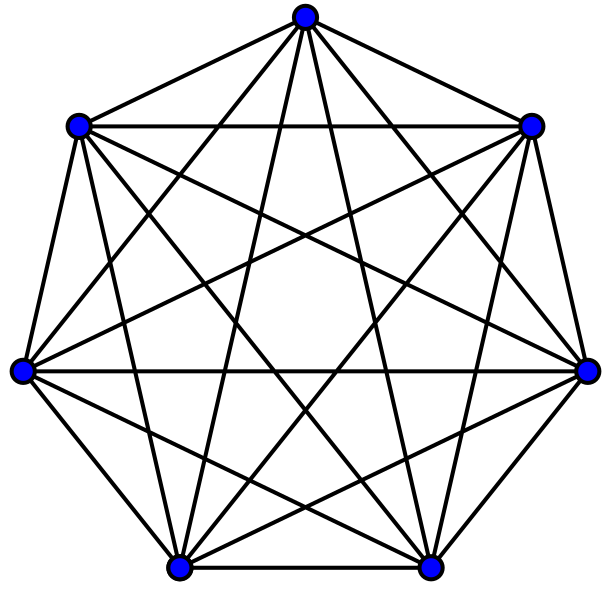
File:Complete graph K7.svg
fig. I: A complete graph with 7 vertices
First, we must understand the idea of a complete graph. A complete graph is a graph such that each node is connected to every other node. A graphical example can be seen in fig. I.

We can use the model of a complete graph to reason about the problem at hand. The nodes in the graph may represent the people in the room, while the connecting edges represent the handshakes that must take place. As such, the key to solving the Handshake Problem is to count the edges in a complete graph.

But it would be silly to draw out a graph and count the edges one-by-one in order to solve this problem (and would take a very long time for large values of $n$), so we'll use math!

The Solution


To find the solution, we have to make a few key observations. The easiest way to start out in this case is to map out the first few complete graphs and try to find a pattern:

Let $n$ = the number of nodes, $e$ = the number of edges.
  • $n = 1 \Rightarrow e = 0$
  • $n = 2 \Rightarrow e = 1$
  • $n = 3 \Rightarrow e = 3$
  • $n = 4 \Rightarrow e = 6$
At this point, you may be noticing a pattern. As $n$ increases, we're adding $n -1$ edges. This makes sense -- each time a new node is introduced, it must connect to each node other than itself. In other words, $n-1$ connections must be made.

It follows that the number of the edges ($e$) in a complete graph with $n$ vertices can be represented by the sum $(n-1) + (n-2) + \dots + 1 + 0$, or more compactly as:
$$\sum_{i=1}^n i-1$$
You may already know from summation laws that this evaluates to $\frac{n(n-1)}{2}$. Let's prove it.

The Proof

Theorem: $\forall n \in \mathbb{N} : \sum_{i=1}^{n} i-1 = \frac{n(n-1)}{2}$

Proof:  Base case: Let $n = 1$. Then, $\frac{1(1-1)}{2} = \sum_{i=1}^1 i-1 = 0$.
Inductive case: Let $n \in \mathbb{N}$. We need to prove that $\frac{n(n-1)}{2} + n = \frac{n(n+1)}{2}$.
$$\begin{array} {lcl}
   \frac{n(n-1)}{2} + n & = & \frac{n(n-1)+2n}{2} \\
   & = & \frac{n^2 - n + 2n}{2} \\
   & = &  \frac{n^2 + n}{2} \\
   & = & \frac{n(n+1)}{2}■\end{array}$$
We can now use the theorem knowing it's correct, and, in fact, provide a solution to the original problem. The answer to the Handshake Problem involving $n$ people in a room is simply $\frac{n(n-1)}{2}$. So, the next time someone asks you how many handshakes would have to take place in order for everyone in a room with 1029 people to shake each other's hands, you can proudly answer "528906 handshakes!"

Until next time,

Ben

Wednesday, January 16, 2013

Comonadic Trees

We've seen in the previous post what monads are and how they work. We saw a few monad instances of some common Haskell structures and toyed around with them a little bit. Towards the end of the post, I asked about making a Monad instance for a generalized tree data type. My guess is that it was relatively difficult. But why?

Well, one thing that I didn't touch on in my last post was that the monadic >>= operation can also be represented as (join . fmap f), that is, a >>= f = join \$ fmap f a, as long as a has a Functor instance.

join is a generalized function of the following type:

 $$ join :: (Monad ~m) \Rightarrow m ~(m ~a) \rightarrow m ~a $$

Basically, this function takes a nested monad and "joins" it with the top level in order to get a regular m a out of it. Since you bind to functions that take as and produce m as, fmap f actually makes m (m a)s and join is just the tool to fix up the >>= function to produce what we want.

Keep in mind that join is not a part of the Monad typeclass, and therefore the above definition for >>= will not work. However, if we are able to make a specific join function (named something else, since join is taken!) for whatever type we are making a Monad instance for, we can certainly use the above definition.

I don't want to spend too much time on this, but I would like to direct the reader to the Monad instance for [] that I mentioned in the last post -- can you see any similarities between this and the way I structured >>= above?

Now back to the Tree type. Can you devise some way to join Trees? That is, can you think of a way to flatten a Tree of Tree as into a Tree a?

This actually turns out to be quite difficult, and up to interpretation as to how you want to do it. It's not as straightforward as moving Maybe (Maybe a)s into Maybe as or [[a]]s into [a]s. Maybe if we put a Monoid restriction on our a type, as such...

$$ instance ~(Monoid ~a) \Rightarrow Monad ~(Tree ~a) ~where ~\dots $$

...we could use mappend in some way in order to concatenate all of the nested elements using some joining function. While this is a valid way to define a Tree Monad, it seems a little bit "unnatural." I won't delve too deeply into that, though, because that's not the point of this post. Let's instead take a look at a structure related to monads that may make more sense for our generalized Tree type.

What is a comonad?

Recall the type signature of >>= for Monads:
$$ (>>=) :: (Monad ~m)  \Rightarrow m ~a \rightarrow ~(a \rightarrow m ~b) \rightarrow m ~b $$
That is, we're taking an m a and converting it to an m b by means of some function that operates on the contained type. In other words, we're producing a new value using elements contained inside the Monad. Comonads have a similar function:
$$ (=>>) :: (Comonad ~w) \Rightarrow w ~a \rightarrow (w ~a \rightarrow ~b) \rightarrow w ~b $$
The difference here is that the function that we use to produce a new value operates on the whole -- we're not operating on the elements contained inside the Comonad, but the Comonad itself, to produce a new value.

We also have a function similar to the Monadic return:
$$ coreturn :: (Comonad ~w) \Rightarrow w ~a \rightarrow a $$
Whereas return puts a value into a Monadic context, coreturn extracts a value from a Comonadic context.

I mentioned the Monadic join function above because I would also like to mention that there is a similar operation for Comonads:
$$ cojoin :: (Comonad ~w) \Rightarrow w ~a \rightarrow w ~(w ~a) $$
Instead of "removing a layer," we're "adding" a layer. And, as it turns out, just as a >>= f can be represented as join \$ fmap f a, =>> can be represented as:
$$ a ~=>> ~f = fmap ~f ~\$ ~cojoin ~a $$

The full Comonad typeclass (as I like to define it) is as follows:

$$ class ~(Functor ~w) \Rightarrow Comonad ~w ~a ~where \\
\hspace{22pt}coreturn :: (Comonad ~w) \Rightarrow w ~a \rightarrow a \\
\hspace{38pt}cojoin :: (Comonad ~w) \Rightarrow w ~a \rightarrow w ~(w ~a) \\
a ~=>> ~f = fmap ~f ~\$ ~cojoin ~a $$

By now, it should at least be clear that Monads and Comonads are related -- it shouldn't be hard to see why they are so similar in name!

Note: There is a package called Control.Comonad on Hackage. It uses different names for the Comonad operations, but they do the same things. It's a good package, but I wanted to show how Comonads are built and use the operation names I used to make things clearer.


What can I do with Comonads?


As it turns out, the Tree a structure that I've been mentioning fits into the Comonadic context quite well, and provides a simple example as to how Comonads work.

We'll start with the implementation of the Comonad typeclass mentioned above:


Then we'll go ahead and make a Functor instance of our Tree a data type:


From here, we're able to make a Comonadic Tree like so:


The only real point of confusion here is in the cojoin function for Nodes. But, all we are doing is wrapping the entire node in a new node, and then mapping cojoin over every child node of the current node to produce its children. In other words, we're turning a Node a into a Node (Node a), which is exactly what we want to do.

So what can we do with a comonadic tree? Let's tackle a simple problem. Say we're hanging out in California, and we want to get to the East coast as quickly as possible. We don't really care where on the East coast we end up -- we just want to get there. We can map out the different paths that we can take, along with the time it takes to get to each one. In other words, we're going to model spots on the map as Nodes on a Tree and give them a weight corresponding to the time it takes to get there. We can model this situation with a Tree as follows:


The number of each Node marks its distance from the previous Node. The root Node of the Tree is the starting point, so it is 0 distance away from itself.

What we want to do to find the shortest path through the country is essentially, as follows. First, we're going to need to check the deepest nodes, and find their minimum distance children. We will add the distance of the Node closest to the one we're examining to its own distance, to find the shortest way to get from the node we're examining to the destination. Once all of that has been done, we'll need to traverse up the tree, repeating this as we go. By the end of the algorithm, the root Node will be marked with the shortest distance to the destination.

Now, that may sound somewhat iterative in nature, but we're going to morph this into a comonadic operation. First, let's take a look at a function we can use to find the minimum distance to the next level of our tree:


This is relatively simple, and does precisely what was mentioned above: adds the minimum value contained in the connected Nodes to the parent Node. Next, take a look at the type signature. We can see that this function produces a new number from a tree full of numbers. This coincides precisely with the function type we need to use with =>>, so we'll be able to use it to get exactly what we want.

The rest is very simple:


This produces a tree full of the minimum distances from each node to the East coast. Pulling the actual value out is as easy as calling coreturn on the resultant tree.

Thanks for reading!

Ben

For further reading on Comonads, I recommend the article Evaluating Cellular Automata is Comonadic.

Wednesday, January 2, 2013

Introductory Monads

What is a Monad?

If you've used Haskell before, chances are that you've heard the term "monad" a good bit. But, you might not know what they are, or what they are really used for. It is my goal in this blog post to shed some light on what monads are, introduce and define few simple ones, and touch on their usefulness.

I will assume basic familiarity with Haskell syntax in this blog post. A working knowledge of monoids and functors will also be beneficial, although not strictly necessary.

Without further ado, let's go ahead and look at the Monad typeclass:


We can see a Monad has two operations, return and >>= (this is commonly pronounced "bind"). You may suspect that you know what return does from other programming languages, but be warned: Haskell's return is very different! Haskell's return only operates on Monads, and essentially acts as a "wrapping" function. That is, if you call return on a value, it will turn it into a monadic value of that type. We will look at an example of this shortly. The second operation, >>=, takes two arguments: an a wrapped in a Monad m (I will refer to this as m a from now on), and a function that converts an a to b wrapped in the same type of Monadm. It produces a value of type b, wrapped in a Monad m (I will call this m b from now on). This may sound complicated, but I'll do my best to explain it after showing the most basic Monad type, namely, the Identity Monad:


Also defined in Control.Monad.Identity

The Identity data declaration defines only one type: Identity a. Basically, this is just a wrapper for a value, and nothing more. return is simply defined as Identity. We can, for example, call return 3 and get an Identity 3. Turning values into Identitys is as simple as that. The bind function may look a little bit more obscure, though. Let's look closely: We first use pattern matching to be able to operate on the type that the Identity Monad wraps (Identity a), bind it (>>=) to a function (f). Since f converts normal values into monadic ones (look at the type declaration), we can simply apply f to a, and we've produced a new Identity. I've provided a couple of examples of how this works. addThree adds 3 to an Identity Int (m1) and getLength turns an Identity [a]  (m2) into an Identity Int. Both of the bind examples produce the value Identity 6. Can you see why?

I want to take a little sidebar here and try to explain how I understand Monads before moving on. Basically the real tough part of understanding Monads is just understanding >>=. A little bit of dissection can explain a lot, but it took me months to really grasp the concept. On the surface, you're morphing an m a into an m b. At first, I thought that the m's in the type signature were allowed to different types of Monads. For instance, I thought that Monads made it possible to bind Identity Ints to functions that produced [String]s (we'll look at the list Monad in a minute). This is wrong, and for good reason! It was incredibly confusing to think about a function that could generalize to this degree and it is, to my knowledge, not possible to do so. The Monad (wrapper) type is retained, but the wrapped type can be changed by means of the function you bind to.

The second thing that I want to stress is what >>= really does. What we're doing with the >>= function is turning an m a into an m b, but it's not so direct as you might want to think. The function argument in >>=  ( (a -> m b) ) was really confusing to me to begin with, so I'm going to try to explain it. The function you're binding your m a to must take an a and return an m b. This means that you're acting on the wrapped part of the Monad in order to produce an entirely new Monad. It took me a while to realize what exactly was happening, that I wasn't supposed to be directly converting m a to m b by means of my argument function (that's actually what >>= is for). Just remember that the function you bind to should operate on an a to produce an m b.

With that knowledge, let's take a look at some more examples of Monads:

More Monads


If you're a Haskell user, you're likely already familiar with the Maybe data type:


Defined in the Prelude

The Maybe Monad is hardly an extension of the aforementioned Identity Monad. All we are really adding is the functionality to fail -- that is, to produce a Nothing value if necessary. In fact, the Just a type is exactly the same as Identity a, except that a Nothing value anywhere in the computation will produce a Nothing as a result. Next, we'll look at the Monad instance for lists:


Defined in the Prelude

The list Monad is a little more complicated, but it's really nothing too new. For return, we just have to wrap our value inside a list. Now, let's look at >>=concatMap actually is the >>= instance for lists. Why? Well, concatMap is, simply, (concat . map). We know that map takes a list of as and maps a function over them, and concat is a function that flattens lists, that is, turns [[a]]s into [a]s. When we compose these two functions (or use concatMap), we're making a function that must produce [[a]]s out of [a]s, and then flatten them back to [a]s. That is exactly how >>=  works for lists! Now, let's take a look at a slightly more complicated Monad:


Also defined in Control.Monad.Instances

This one requires some explanation, because it's a bit of a leap from the last three, since we're defining a Monad instance for functions. I have added a couple of comments in the above code in order to further explain how everything is working in the (->) r Monad.

Well, first things's first. We define return as const, which takes some arbitrary argument and produces a function that produces a constant value (what we pass in to return). This is exactly what we want; a minimal context for functions.

(>>=) is a bit more complex. First, let's take a look at the type signature, specific to this Monad. We're binding a function (r -> a) to a function (a -> (r -> b)) to produce a function of type (r -> b). So in the declaration of the function, f is of type (r -> a) and g is of type (a -> (r -> b)). I've conveniently named the argument our function is going to take r, for clarity. This is what the user will pass into the function that (>>=) produces.

f takes an r, so we apply the value from the lambda into it to produce an a. We then use that a to produce an (r -> b), using g. This produces our function, but it needs to be fed some value, so we finally apply it to r in order to complete everything. If any of this sounds confusing, try to work through it on paper and read the comments in my code -- after a bit of staring, it should start to make sense.

I've also implemented the mean function here, using the (->) r Monad with and without do-notation. I think it's a pretty elegant way to express it.

We've only seen the tip of the iceberg when it comes to Monads, but this should serve as a good basic introduction. Once you get used to seeing Monads, they become a bit less scary. The more time you spend with them, the more comfortable you'll feel with them.

Before I end this post, I want to leave a question for the reader. Given the general Tree data type represented below, can you intuitively make a Monad instance?


I'll explain why this is difficult when we talk about a similar mathematical type in the next post.

Thanks for reading,

Ben

For more introductory monad material, I suggest the following resources:

Sunday, December 16, 2012

Uncountable Infinity and The Diagonalization Method

Introduction


I took a class on Discrete Mathematics this past semester, and one of the topics we covered very briefly was the concept of countable and uncountable infinity. I didn't end up getting a great grasp on it, however, and the topic I'm writing about today didn't make a lick of sense to me at the time. It was never covered on exams, so I never had to revisit the idea. But, I've been reading through Douglas R. Hofstadter's Gödel, Escher, Bach, and it just so happens that the topic is covered in the book. As it turns out, it's not actually too difficult a thing to understand, so I'm hoping to relay the ideas in this blog post. If you've heard about the concept of multiple infinities but not understood it, hopefully this will shed some light! If you haven't yet heard about the concept of multiple infinities, enjoy the read!

Anyway, on with the show...

Natural Numbers Form an Infinite Set


It is a widely known fact (axiom of ZFC Set Theory) that the set of natural numbers (all non-negative integers) extends on to infinity. That is to say, there is no "largest" natural number. We can order the set of natural numbers in this way:

$$
\begin{matrix}
N_0 & = & 0 \cr
N_1 & = & 1 \cr
N_2 & = & 2 \cr
N_3 & = & 3 \cr
N_4 & = & 4 \cr
N_5 & = & 5 \cr
\cdots
\end{matrix}
$$
This ordering comes very naturally to us. The nth term of the set of natural numbers will be, simply, n. Because of this fact, we can tell that this set of natural numbers contains all of them -- if you give me any natural number, it will correspond to the nth number in the set.

There is a similar way of ordering the integers (including negatives) in this fashion. It may not be heavily intuitive at first, because we have to extend in two directions rather than one. But, it is apparent that this ordering of integers will allow us to find the location of any integer in it:

$$ \begin{matrix}
Z_0 & = & 0 \cr
Z_1 & = & 1 \cr
Z_2 & = & -1 \cr
Z_3 & = & 2 \cr
Z_4 & = & -2 \cr
Z_5 & = & 3 \cr
\cdots
\end{matrix}
$$
Any integer, positive or negative, is contained in this infinite set. An infinite set that can be ordered in a way such as this is said to be countably infinite.

What About Real Numbers?


For the purposes of this post, we're going to focus on the real numbers between 0 and 1. We can represent them in the following way:

$$
\begin{matrix}
R_0 & = & 0 . & a_0 & a_1 & a_2 & a_3 & a_4 & \cdots \cr
R_1 & = & 0 . & b_0 & b_1 & b_2 & b_3 & b_4 & \cdots \cr
R_2 & = & 0 . & c_0 & c_1 & c_2 & c_3 & c_4 & \cdots \cr
R_3 & = & 0 . & d_0 & d_1 & d_2 & d_3 & d_4 & \cdots \cr
\cdots
\end{matrix}
$$
We can see that this set goes on forever, that is, extends infinitely, just as the set of integers and naturals does. However, the set of real numbers is "built" in a different way. Both of these facts are important in what we will observe next.

Cantor's Diagonalization Method


I claim now that I can produce a number that the above set does not contain. To do this, I will be using Georg Cantor's famous Diagonalization Method. Here's how it works.

First, I will grab the $n$th term of each $n$th element in our set of real numbers to compose a new number, like so:

$$
\begin{matrix}
R_0 & = & 0 . & \color{red}{a_0} & a_1 & a_2 & a_3 & a_4 & \cdots \cr
R_1 & = & 0 . & b_0 & \color{red}{b_1} & b_2 & b_3 & b_4 &\cdots \cr
R_2 & = & 0 . & c_0 & c_1 & \color{red}{c_2} & c_3 & c_4 & \cdots \cr
R_3 & = & 0 . & d_0 & d_1 & d_2 & \color{red}{d_3} & d_4 & \cdots \cr
\cdots &&& &&&& \color{red}{\ddots}
\end{matrix}
$$
So my new number becomes:

$$
\begin{matrix}
0 . & a_0 & b_1 & c_2 & d_3 & \cdots
\end{matrix}
$$
Now I'm going to perform some transformation on each digit of this number to produce a new digit. A simple way (the simplest way?) to do this would just be to add 1 to each digit. This will produce a new number as follows:

$$
\begin{matrix}
M_0 & = & 0 . & a_0 + 1 & b_1 + 1 & c_2 + 1 & d_3 + 1 & \cdots
\end{matrix}
$$
We can see $M_0$ cannot be the same as $R_0$ because its first term differs. Same goes for $R_1$ with its second digit, and so on, ad infinitum. Therefore, each element of set of real numbers between 0 and 1 is going to differ from $M_0$ by at least one digit. We can conclude from this observation that our (infinite!) set of real numbers excludes $M_0$. That is to say, our set of real numbers between 0 and 1 isn't actually complete, and cannot actually be complete.

That last part, "cannot be complete," may sound confusing, because, why can't we just add $M_0$ to the set, and call it complete?

Well, let's do it! We'll tack on $M_0$ to the set to produce something like this:

$$
\begin{matrix}
M_0 & = & 0 . & a_0 & b_1 & c_2 & d_3 & e_4 & \cdots \cr
R_0 & = & 0 . & a_0 & a_1 & a_2 & a_3 & a_4 & \cdots \cr
R_1 & = & 0 . & b_0 & b_1 & b_2 & b_3 & b_4 & \cdots \cr
R_2 & = & 0 . & c_0 & c_1 & c_2 & c_3 & c_4 & \cdots \cr
R_3 & = & 0 . & d_0 & d_1 & d_2 & d_3 & d_4 & \cdots \cr
\cdots \cr\
\end{matrix}
$$
You might foresee what's going to happen next. We can perform diagonalization again:

$$
\begin{matrix}
M_0 & = & 0 . & \color{red}{a_0} & b_1 & c_2 & d_3 & e_4 & f_5 & \cdots \cr
R_0 & = & 0 . & a_0 & \color{red}{a_1} & a_2 & a_3 & a_4 & a_5 & \cdots \cr
R_1 & = & 0 . & b_0 & b_1 & \color{red}{b_2} & b_3 & b_4 & b_5 & \cdots \cr
R_2 & = & 0 . & c_0 & c_1 & c_2 & \color{red}{c_3} & c_4 & c_5 & \cdots \cr
R_3 & = & 0 . & d_0 & d_1 & d_2 & d_3 & \color{red}{d_4} & d_5 & \cdots \cr
\cdots & & & &&&&& \color{red}{\ddots} \cr
\end{matrix}
$$
...to produce a new number...

$$ \begin{matrix} 0. & a_0 & a_1 & b_2 & c_3 & d_4 & \cdots \end{matrix} $$
We perform some transformation on its elements (let's add one, again) in order to get a new number, say $M_1$.

$$ \begin{matrix} M_1 & = & 0. & a_0 + 1 & a_1 + 1 & b_2 + 1 & c_3 + 1& d_4 + 1 & \cdots \end{matrix}$$
However, note that $M_1$ must differ from $M_0$ now, as well as every other number in the set, by at least one digit. As such, $M_1$ must not yet exist in the set. We can add $M_1$ to the set, and repeat this process as many times as we want, but we'll always be able to produce a number outside of the set! We call a set with this fascinating property uncountably infinite.

What does this mean? We can see that the set of integers is countably infinite, while the set of real numbers between 0 and 1 is uncountably infinite. We have successfully proven in this blog post that there are actually more numbers between 0 and 1 than there are integers!

Cantor's Diagonalization Method has been used to prove several difficult problems in Mathematics, including the Church-Turing Theorem and Gödel's Incompleteness Theorems. All three of these theorems have had major effects on the nature of Mathematics, so you can see that Cantor's Diagonalization Method can be quite useful!

If you have any questions, or if anything was unclear, please leave a comment!

Until next time,

Ben

Thursday, December 6, 2012

Graphs and Topological Sorting in the Functional Paradigm

What is a Graph?

From Wikipedia
In mathematics, a graph is a representation of a set of objects where some pairs of the objects are connected by links. The interconnected objects are represented by mathematical abstractions called vertices, and the links that connect some pairs of vertices are called edges.
Simply put, a graph is just a bunch of points with links between them. A road map is a simple example: roads  being edges, and intersections being vertices.  In fact, Google maps uses graphs for just this purpose! Graphs are widely used in a wide variety of places. Facebook uses graphs to model your friend connections and likes. In fact, the entire internet is just a giant graph; websites act as vertices, with hyperlinks as edges. Graphs are highly useful structures, as they can be used to model many different types of situations, and as such, they will be the focus of this blog post. I am going to discuss one way to represent a graph in the Haskell programming language, and how to functionally solve a common problem using graphs.

Graphs are often represented visually like this:

Graph representing abstract data

This graph links the first six letters of the alphabet in an arbitrary way. This data doesn't really mean anything, but it will serve as a simple foray into the world of graphs, and provides an initial graph to work towards representing in Haskell.

Let's get right to it; here's the data structure we'll be using, along with some convenience methods:


First we define the actual Graph a data type: It's simply a set vertices and edges in the form of 2-tuples (The tuple (a, b) connects vertex a to vertex b), which fits our definition. I've also defined the removeEdge method, which does just what you'd expect. The outbound and inbound methods find the outbound and inbound connections to any point in the graph, respectively. They make use of the polymorphic connections method in order to get this done in a small amount of code. Finally, the Graph module exports the relevant functions at the top of the file.

Now that we've got our framework in order, we can go ahead and build the graph we mentioned above:


We import the Graph module and define a simple Letter data type, then build our Graph from it. The set of vertices are the letters A, B, C, D, E, and F, and the edges are modeled as above.

Now that we know how to build graphs, we can start modeling more important information with them.


Modeling Actual Scenarios using Graphs

Suppose some of the characters from NBC's Parks and Recreation have just finished competing in a dance competition, and we know the following about their rankings:

Leslie beat April.
April beat Ann.
Ron beat April.
Ron beat Ann.
April beat Andy.
Leslie beat Ron.
Andy beat Jerry.
Ron beat Andy.
Ann beat Jerry.
Leslie beat Andy.
Ann beat Andy.

This is a little hard to understand, so why don't we model it as a graph to make it a little more readable? Each person can be represented as a vertex, with outgoing edges representing connections to the people they beat.


A graph of dance competition results

It would be nice to be able to be able to read scenarios like this from a text file containing the important data and parse it into a graph. Let's go ahead and set up a function to do this for us, so we don't have to hard-code each and every graph that we want to use:

Here's our data file, with a list of space-separated connections, one on each line:


And our parsing function:


The graphFromFile function takes a String and returns an IO (Graph String).  The function reads a file, parses it into two important pieces: verts (the set of all unique strings in the file, or, our vertices) and conns (the set of connections between strings in the file). It then builds a Graph from this data, wraps it in the IO monad with return, and gives it back.

Now you might have been wondering from the beginning of this section what the ranking from the dance competition was (maybe you even figured it out on your own!). How do we do this programmatically, using our graph?

Enter Topological Sort

Again, from Wikipedia:
In computer science, a topological sort of a directed graph is a linear ordering of its vertices such that, for every edge uvu comes before v in the ordering.
In our case, this just means that each person must come before all of the people that he or she beat in the competition, in the ordering.

The basic procedure for topological sort is as follows:

L = {} --sorted list
S = Set of vertices with no incoming connections
while S is not empty:
    for each vertex v in S with no incoming connections:
        push v to L
        for each edge e from v to u:
            remove e from graph
            if u has no more incoming connections:
                push u to S

if edges still exist in the graph:
    error: there is at least one cycle in the graph

else return L

If you do not understand this, I urge you to work through topologically sorting a graph on paper first; it's not too tough to understand once you've done it on paper, but can get a little confusing in psuedocode.

The problem with this algorithm is that you see a ton of loops -- control structures that we do not have in Haskell. Therefore, we must rely on recursion, folds, and maps to achieve what we want to do. Here's how it looks:


Our tsort function first finds the elements in the graph with no incoming edges using the function noInbound.  We pass this into a sub-routine tsort' that takes a sorted list l, a list of vertices with no incoming connections (n:s), and a graph g.

We operate on the first element of the set of vertices with no incoming connections n, finding outEdges (the outgoing edges from n), and outNodes (the nodes that n points to). We build a new graph g' with the outEdges removed, and find the nodes in g' with no inbound connections, and add them to s.

We then recursively call tsort' with these new parameters (and prepend our current n to the sorted list), until there are no more nodes to check. At this point, if the edge list in the graph is empty, all is well and we return the list of sorted elements. Otherwise, an error is thrown stating that there is at least one cycle in the graph.

Now that we've got that, we're ready to find out how everyone ranked in the dance competition!


This produces the output:
["Leslie", "Ron", "April", "Ann", "Andy", "Jerry"]

(Of course Jerry lost.)

Conclusion

As you can see, Graphs are very useful data structures. They can be used to model a huge variety of things (see how many more you can come up with, they're everywhere!). Topological sort in particular is a pretty remarkable algorithm, and can be applied in many different situations from the one above. For example, finding paths through college courses with prerequisites. It's even used in UNIX systems to schedule processes according to their dependencies.

Hope you enjoyed the post! Until next time,

Ben